


ASHRIVER REALTY | BUYER'S GUIDE 2026
The Pattaya Property Buyer's Guide 2026
A clear guide for international buyers considering condos, villas, and second homes.
By Brandon Alsup | Ashriver Realty | Updated May 2026
ESSENTIAL READING
attaya has a reputation that tends to arrive before you do. It follows you into conversations at dinner parties in London and Sydney and Chicago, usually delivered with a knowing look. Most of it is outdated, some of it was always exaggerated, and
P
almost none of it explains the people you actually meet here.
Those people are worth knowing about, because they are probably closer to you than you expect.
Our circle in Pattaya includes a half-Thai, half-British airline pilot married to a Russian woman. A website developer from Moscow and a pair of entrepreneurs from Siberia who never stop talking about how much they love the heat. An American-French couple whose daughter attends the French school. Friends from Hong Kong. An Irish man who works oil rigs on a three-weeks-on, three-weeks-off schedule and has made Pattaya his base between rotations. A half-Thai, half-French woman whose family runs an interior design company, married to a Frenchman. A Lithuanian real estate developer with a Thai partner who runs a pool villa cleaning business. An Israeli woman, a developer, married to a Thai. The list goes on, and it covers almost every nationality, profession, income level, and family configuration you can imagine.
What is striking is not the diversity itself — it is how naturally everyone gets along. People who might never have crossed paths back home end up at the same beach club, the same school events, the same dinner tables. Something about choosing to be somewhere that most people back home do not fully understand creates an immediate common ground.
Ask any of them why they are here and you will get a different answer. Some followed a Thai spouse or partner. Some visited so many times over so many years that leaving eventually stopped making sense. Some wanted out of the cold — our Siberian friends are emphatic on this point. Some were drawn by the food, the pace, the tropical ease of a life lived mostly outdoors in shorts. Some had children and found that a good quality of life here was simply more accessible than the version they were working toward back home. And yes, for some, the economics played a significant role. But to say that economics is the through-line would flatten something more interesting.
What Pattaya offers is a particular kind of freedom — a slightly less uptight version of daily life, where the weather is warm, the food is extraordinary, the sea is close, and the general atmosphere does not take itself too seriously. That is not a trivial thing. For people who have lived inside competitive, high-cost, high-pressure cities for a decade or two, it turns out to matter quite a lot.
The economics are real, and worth being honest about. Housing is where Pattaya changes the equation most dramatically for buyers coming from Western markets — we bought our home here for roughly 40 to 50 percent of what an equivalent property would have cost in the United States, with a monthly mortgage payment of around THB 24,000. That kind of difference restructures what a life here can look like financially. But Pattaya is not universally cheaper than "home", and the families we know who made this move without running the full numbers have sometimes been surprised. Bilingual schools and International school fees start around THB 167,400 per year per child at good schools — for a family with two children, that is a serious annual line item.
I'll tell you from personal experience, in 2026 quality private health insurance for a family of four costs us around THB 160,000 a year for inpatient coverage. These are real costs, and anyone moving here with a family should plan for them clearly. We cover the full cost-of-living picture in a dedicated guide - some are surprised at how close living costs really are.
What we can say with confidence, from years of living here and knowing hundreds of people who have made the same choice: most of them, when asked, will tell you they are not going back. Not because Pattaya is perfect — it is not — but because what they found here, whatever particular combination of things drew them, has turned out to be worth staying for.
This guide is for people who have gotten past the initial curiosity and want to understand how buying property here actually works. It is written by people who live here, own property here, and have personally navigated the Thai banking and property system — including securing a home loan from UOB Thailand. It is not a sales pitch for Pattaya, and it is not a pitch for any particular development. Our goal is to give you enough clarity to make a confident, informed decision, whatever that decision turns out to be.
THE FUNDAMENTAL RULE
The One Rule That Simplifies Everything
Foreign property ownership in Thailand sounds complicated until you understand the one rule that organizes everything else:
Foreigners cannot own land.
Everything else flows from that single legal reality.
That is it. Everything else — the various structures, the lease arrangements, the ownership debates — flows from that single legal reality. Thai law expressly permits qualified foreign nationals to hold freehold title over condominium units, subject to two main conditions. First, the building must have remaining quota in its foreign ownership allocation — the law caps foreign freehold ownership at 49 percent of the total unit area in any given condominium project. Second, your purchase funds must be remitted into Thailand from abroad in foreign currency and converted into Thai baht here. The bank that receives the transfer issues you a document called a Foreign Exchange Transaction certificate, or FET form, which proves the funds originated offshore. You will need this document at the point of title transfer — losing it or not obtaining it properly is a problem that is very difficult to fix later.
If you are buying a condominium as a foreign national, that is the structure. It is legally clean, widely understood, and gives you the same title security over your unit that a Thai national has over theirs.
Villas, land, and houses are a different conversation entirely.
Foreigners cannot own land in Thailand. Full stop.
We say this plainly because some developers and some agents will present "creative structures" — Thai company ownership, nominee arrangements, complex leasehold configurations — that appear to solve this problem. We do not recommend any of them as a standard approach, and we will not present them as solutions in this guide. The law is clear, and structures designed to work around a clear law carry legal risk that tends to materialize at the worst possible moment: a dispute, a death, a divorce, a change in government enforcement priorities.
The one villa path we find genuinely defensible is straightforward: a foreign buyer who is married to a Thai national can purchase land and a villa in their spouse's name, with proper independent legal counsel, and with full understanding of what that arrangement actually means. The land is your spouse's property under Thai law. The authorities will require a written declaration that the funds are the Thai spouse's separate assets and that the foreign spouse has no ownership interest in the land. This is not a paperwork technicality — it reflects the actual legal ownership structure.
We know this from personal experience. Our family home is in my wife's name. The loan is in her name. That is how it works, and we are not uncomfortable saying so, because understanding it clearly from the start is exactly what protects both parties in the long run.
For legal structures, title verification, due diligence on land purchases, and a deeper look at what the law actually says, we publish a separate guide: COMING SOON!

GEOGRAPHY OF PATTAYA
The City Itself: Basic Zones and Neighborhoods
Pattaya is not one neighborhood — it is a loose string of distinct communities stretched along about 30 kilometers of coastline and inland territory, each with a different character and a different buyer profile. Understanding this geography early saves a lot of time.
Keep in mind this is a rough and simplified overview of these areas. Inside each area are distinct pockets that offer a wide variety of price points and lifestyles. But in general, this Pattaya zone break down will get you started!
Wongamat and Naklua occupy the quieter northern end of the city. The beaches here are calmer, the pace is slower, and the Sanctuary of Truth — a remarkable hand-carved wooden structure that has been under continuous construction since 1981 — sits at the northern tip. This is where much of Pattaya's genuinely premium beachfront condo supply is concentrated. Buyers prioritizing quality of life, owner-occupier comfort, and resale credibility to future international buyers tend to end up here. For most of the buyers we work with, this is where the conversation starts.

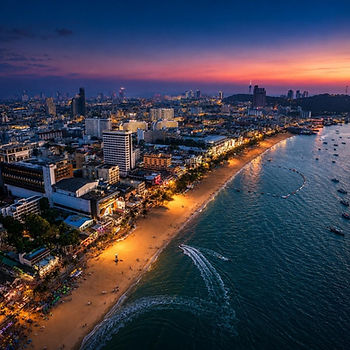
Central Pattaya is the urban heart — walkable, dense, and perpetually alive - events and festivals happen here year round! Pattaya Beach Road runs through it, the restaurants are everywhere, and the energy is unmistakably city-like. For buyers who want maximum rental demand from short-stay visitors and strong footfall convenience, the numbers here are compelling. For buyers who want to sit quietly on their balcony with a coffee and watch the sea, it is usually not the right fit.
Pratumnak Hill, nestled between South Pattaya and Jomtien, occupies a genuinely balanced position: close to the city, slightly elevated, quieter than the strip, and home to one of Pattaya's most established long-term expatriate communities. The views from the hill are genuinely good. It has a settled, residential quality that makes it easy to imagine living in, rather than just visiting. As with most places in Thailand, there's no shortage of great restaurants with fantastic views. Also, a couple of sauna's that will become part of your routine if you live here!


Jomtien runs south along its own beach, with its own dining scene, its own community rhythm, and considerably less noise than central Pattaya. The Thailand Tourism Authority describes it as a quieter resort than Pattaya Beach, which is a useful way to frame it for buyers: still coastal, still convenient, but designed for people who are actually living here rather than passing through for the weekend. Many full-time expat families settle in Jomtien. This beach has its own events and attractions - concerts, fireworks, water sports like wind surfing, and beach sports - throughout the year.
Na Jomtien, further south still, is where the city transitions into a more open resort corridor — larger plots, more space between buildings, a different pace entirely. Several of Pattaya's newer premium beachfront projects have launched here, and the area around Nong Nooch Tropical Garden (a genuinely impressive botanical and cultural landmark) attracts buyers looking for coastal living with more breathing room. The trade-off is distance — Na Jomtien is further from the daily amenities that make Jomtien or central Pattaya convenient.


Bang Saray, about 16 kilometers south of central Pattaya, is a fishing village that has slowly become a destination in its own right. It is calm, coastal, and genuinely slower than anything closer to the city. For buyers seeking a second home or a deliberate retreat from their home country — people who are not trying to replicate urban life but step away from it — Bang Saray is worth a serious look. Just be clear-eyed that you are choosing distance from the city's infrastructure.
BUYER'S COST GUIDE
What Your Money Actually Buys
Abstract price ranges are not as useful as a real example. Here is what a purchase at roughly THB 6 million — a realistic entry point for a quality one-bedroom unit, 34.75sqm, in a good building in Jomtien or Pratumnak with an ocean view — actually costs from first payment to registered ownership.
A note on what property we recommend — and why
Below is a generalized look at what your budget can reach across the Pattaya market. But before the numbers, something worth saying directly: every buyer comes to Pattaya with different needs, a different timeline, and a different relationship to the asset they're buying. An older unit with more square meters and a lower price point can absolutely be the right choice for the right person. We are not here to tell you otherwise.
What we are here to do is be honest about what you are trading when you make that choice.
Older buildings typically come with aging infrastructure, higher maintenance levies, less competitive common facilities, and a management structure that has often drifted from its original quality. More importantly — and this is the part buyers sometimes underestimate — they tend to command lower rental rates, attract a narrower pool of resale buyers, and are harder to exit cleanly when the time comes. In a market like Pattaya, where liquidity is thinner than in major capital cities, resale demand is not a detail. It is one of the most important variables in the entire decision.
The projects we recommend share a specific profile. Great locations — either beachfront, close to it, or in areas with sustained long-term demand. Meaningful views, particularly sea views, which consistently command a premium at both the rental and resale stage. New construction with quality materials and well-considered layouts. And critically — a professional operator or branded management agreement in place after handover, which is what actually determines the day-to-day quality of the building over decades, not the developer's marketing materials.
Buying into this profile does not guarantee anything. Pattaya is an emerging market and carries emerging market risk. But it does position the asset well across multiple scenarios: you enjoy it, you rent it, you sell it, or you hold it. A well-located, well-managed, visually compelling unit in a quality building tends to preserve capital and remain in demand regardless of why you eventually need to act on it. That is the angle we recommend from — and the standard every project in our portfolio is held to.
Under ฿5M
Studios and entry-level one-bedrooms in non-premium projects, or older buildings.
฿5M-฿10M
Good one-to-two-bedroom units in mid-tier to solid projects across most neighborhoods
฿10M-฿20M
Premium and branded beachfront product — genuinely highly desirable units in Wongamat, Jomtien, or Na Jomtien
Above ฿20M
Larger 2-3 bedroom units, penthouses, and the upper end of the Pattaya market
BUYER'S GUIDE
New Development vs Resale
The new-versus-resale question in Pattaya maps to a version of the same question in the US, Australia, or UK — with one important structural difference that changes how carefully you need to approach each option.
New Development
bought off-plan during construction
-
Lower entry cost with early-buyer and launch pricing
-
Staged payments across construction milestones — easier on cash flow
-
Foreign quota wide open — practical advantage in a brand-new building
-
Furniture packages and incentives common at launch
-
Delivery risk — what you buy off-plan is what gets built
-
Developer's timeline — delays are common, your schedule is secondary
-
Financial health matters enormously — no standardized escrow protection
Resell
existing units in completed developments
-
See exactly what you're buying — the unit exists, no guesswork
-
Inspect management quality — talk to residents, see the common areas
-
More room to negotiate — particularly in a soft-sentiment market
-
Assess the juristic committee before you commit
-
Quota may be tight if the building is already heavily foreign-owned
-
Older infrastructure — maintenance levies and facility quality vary widely
In Thailand, the standardized buyer protections you may expect from the US or UK — escrow accounts, title insurance, licensed agent accountability — do not exist in the same form. That is not a reason to avoid new development. It is a reason to choose your lawyer carefully and not skip steps.

Off-plan purchases require careful developer due diligence — financial position, EIA approval, and track record on prior completions.
THE THAILAND DIFFERENCE
Developer due diligence has to be done manually
In the US or UK, much of this work is handled by a regulated framework. In Thailand it falls to your lawyer — which is why the choice of legal representation is one of the most consequential decisions in the entire purchase process.
WHAT A LAWYER SHOULD VERIFY
Financial position
Is the developer adequately capitalized to complete the project? Have they drawn down construction financing?
EIA approval
Environmental Impact Assessment — a government review required before major construction can legally proceed.
Track record
Prior project completions, delivery timelines, and the quality of what was actually handed over to buyers.
Many developers, big and small, operating in Pattaya have strong, verifiable track records. The trick is to make sure you are engaging with reputable builders with strong financial positions and buttoned up legal documentation.
ON CHOOSING YOUR LAWYER
Do not use the developer's recommended lawyer. The recommendation is not made in your interest. Find an independent property lawyer — ideally one referred by a buyer who has used them, not a name from a website — and expect to pay ฿15,000–70,000 for a thorough review on a straightforward transaction. That fee is among the most important money you will spend in this process.
THE PURCHASE PROCESS
How buying actually works: the process
The buying process in Thailand is more negotiable and less institutionalized than what most Western buyers are used to. That is both a feature and a risk — and understanding the difference matters before money moves.
1
STEP ONE
Price agreement
After finding a unit, price negotiation happens directly — often more informally than buyers from the US or Australia expect. There is no standardized offer process. Agreement is verbal first, then documented.
2
STEP TWO
Reservation deposit
A deposit of ฿50,000–200,000 takes the unit off the market while contracts are prepared.
Ask before you pay: whether this deposit is refundable if the deal falls apart depends entirely on what is written in the reservation agreement. Read it first.
Typically non-refundable
3
STEP THREE
Independent legal review
Your lawyer reviews the sale and purchase agreement before you sign anything. This is not optional. The developer's recommended lawyer is not your lawyer — they represent the developer's interests. A proper review catches title issues, problematic clauses, and due diligence gaps before money moves.
฿15,000–70,000 · Non-negotiable
4
STEP FOUR
Contract execution & down payment
After signing, a down payment of typically 10–30% of the purchase price is paid. For off-plan purchases, further payments follow construction milestones specified in your contract. These are fixed — the schedule is the developer's, not yours.
5
STEP FIVE
Funds remittance & the FET certificate
The step that catches foreign buyers off-guard most often. Covered in full below.
6
STEP SIX
Title transfer at the Land Department
Covered below. Attend in person if you can.
STEP FIVE — WHAT MOST BUYERS MISS
The Foreign Exchange Transaction certificate
Your purchase funds must arrive in Thailand from abroad, in foreign currency — not transferred internally from a Thai bank account. The receiving bank issues an FET certificate documenting the conversion.
Keep this document with the same care you would give your passport. You cannot transfer a freehold condo unit into your foreign name without it. Losing it, or not obtaining it correctly, is a problem that is very difficult to fix later.
STEP SIX
Title transfer at the Land Department
Both parties — or their representatives with proper power of attorney — appear in person at the Banglamung Land Department. Fees are settled, the chanote is transferred, and the unit is registered in your name.
LOCATION
Banglamung Land Department
The relevant Land Department office for the majority of Pattaya property transactions
ATTENDANCE
In person if possible
Power of attorney is accepted — but attending yourself is worth the effort on a transaction of this size
THE CHANOTE
Nor Sor 4 Jor title
The strongest form of Thai land title document. What you want to see on the title deed you receive
REPRESENTATION
Lawyer present
Your independent lawyer should be present or represented at this step — not just the developer's staff
FROM THE TEAM
We went through a version of this process ourselves — including navigating UOB Thailand's home loan requirements for a property purchase in my wife's name. Thai banks are thorough, documentation-intensive, and not always smoothly bilingual. Having a lawyer and an agent who had direct experience with that specific bank's process was genuinely useful, not just a convenience. We know what these steps feel like from the inside — and that shapes how we work with buyers going through them for the first time.
BUYER'S GUIDE CHAPTER 6
What to Watch Out For
These are the patterns that catch buyers off guard most often. They are not exotic edge cases — they are common enough to cover explicitly, and they recur precisely because they are not obvious until after the fact.
None of the risks below require you to avoid Pattaya real estate. They require you to approach it with the right professional support.
01
THE RENTAL RATE GUARANTEE ISN'T WHAT IT SEEMS
The first thing to watch out for is some developments market guaranteed rental yields of 6, 7, or 8 percent for a fixed term — presented as a sign of investment confidence. In practice, this structure almost always works by building the "guaranteed" amount into the purchase price. The developer raises the price, then pays you back your own money over the guarantee period, effectively receiving a free loan from you at zero cost.
SOME developments truly have great rental returns and really offer a legitimate rental yield generated from operating your purchased unit as a short-term or long-term rental. And guess what? Those projects cost more and are typically a branded project connected with a reputable hospitality operator.
If you are getting a "rental yield" and the building is still under construction, you should for sure have some alarm bells going off!
WHAT TO ASK REGARDING GUARANTEED RENTAL RETURNS
What is the actual market rental rate for this unit type in this location? What does professional management cost? What does realistic vacancy look like? Those numbers matter more than any developer's marketing commitment.
02
THE LOOSELY DEFINED "BRANDED" PROPERTY PROJECT
The second promise to watch out for is the "branded" property promise. Branded residences command a genuine premium in Pattaya — and for good reason when the branding is real. A genuine branded residence has a contractually meaningful affiliation with a recognized hospitality or lifestyle brand, with committed management standards and service delivery obligations. But "branded" is used loosely in Thai property marketing. Branding that exists only in the brochure is not branding at all.
WHAT TO VERIFY
Ask to see the actual brand agreement. Understand what services are contractually committed versus aspirationally described. If the developer cannot produce a signed brand agreement, the premium is not justified.
03
SKIPPING OR MISHANDLING THE FET STEP
The third item to be careful with is the FET step. As covered in the process chapter — if funds arrive in Thailand without proper documentation of offshore origin, freehold title transfer may not be possible. Coordinate with your bank before any money moves. The FET certificate needs to be issued at the point of conversion, not reconstructed afterward.
THE RULE
Funds must arrive from abroad, in foreign currency, into a Thai bank account in your name. The bank issues the FET certificate at the point of conversion. Keep it permanently. There is no workaround if it is missing.
Due diligence checklist — before money moves
Foreign quota status confirmed with juristic office
Independent lawyer engaged — not developer-recommended
Sale & purchase agreement reviewed before signing
Reservation agreement refund terms confirmed in writing
FET certificate process confirmed with receiving bank
Title type verified at Land Dept. — chanote confirmed
Brand agreement reviewed if "branded" development
Rental guarantee structure stress-tested if relevant
BUYER'S GUIDE CHAPTER 7
A Word On Investment

Pattaya's residential market draws both lifestyle buyers and investors — often the same person, looking for both at once.
Many buyers considering Pattaya are not purely lifestyle buyers. They want a property they can enjoy when they are here, rent when they are not, and eventually sell without regret.
That is a reasonable goal, and Pattaya is a real rental market with genuine international demand. It is also a goal that deserves careful, honest analysis — not a brochure.
TYPICAL GROSS RENTAL YIELD
5 – 7%
Quality units in well-managed buildings. Net yield after management and vacancy is lower.
MANAGEMENT COST
15 – 25%
Of rental income. Professional management is non-negotiable if you are not resident.
REALISTIC VACANCY
10 – 20%
Varies significantly by location, building quality, and how the unit is positioned.
AN HONEST NOTE
The lifestyle value of a property — the weeks you actually use it, the quality of life it enables, the optionality it creates — is real. But it does not belong on the same spreadsheet line as gross rental yield. These are different kinds of return and conflating them leads to decisions that disappoint on both dimensions.
DEDICATED GUIDE (COMING SOON!)
Is Pattaya Real Estate a Good Investment in 2026?
Rental yields, vacancy, management costs, currency risk, resale liquidity, and an honest global comparison. Read this before you read anything from a developer's sales team.

ABOUT ASHRIVER REALTY
We live here. Our families are here. We know this market from the inside.
AshRiver is a boutique brokerage focused on Pattaya's residential market. We work across projects and developers rather than representing any single one — which means our job is to find the right property for you, not to sell you what we have exclusive inventory on.
WE HAVE BOUGHT OUR HOME IN PATTAYA
Personal experience navigating the Thai property system from the buyer's side — not from a sales desk.
HONEST ON THE GAPS
We know where the gaps are between what developers promise and what buildings actually deliver after handover.
RAISING OUR FAMILY IN PATTAYA
We know what the school landscape looks like from a parent's perspective and what daily life actually feels like.
INDEPENDENT
No exclusive developer arrangements. We recommend what we believe is right for you — not what earns the highest commission.
PROJECTS WE WORK WITH
We are selective about the projects we represent. Not every new development in Pattaya meets the standard we are comfortable putting our name behind — and we do not take on projects simply because a developer asks us to.
The projects in our portfolio share a consistent profile: developed by companies with a verified track record of delivery, located in areas with sustained long-term demand rather than speculative fringe locations, and positioned to perform across multiple scenarios — as a residence, as a rental asset, and at resale. We look closely at what operator or management company will run the building after handover, because that relationship determines the quality of the asset over decades, not just at launch. We favour projects where the design, materials, and facilities genuinely justify the price — buildings that will age well rather than date quickly. And we look for foreign quota availability, clean title, and proper EIA approval before we put anything in front of a buyer.If a project does not meet that standard, we say so. If we do not know enough about it to have a view, we say that too.
BUYERS WE WORK WITH
Buyers who are serious about the decision
We work primarily with buyers in the THB 7 million and above segment who want complete information, honest guidance on what to avoid, and a considered recommendation — not a quick sale.
If you are early in your research, we are happy to help you think it through.
If you are further along in the process but would like someone on your side or a second opinion, we are here for you.
BEST NEXT STEP
conversation
We are not here to sell you something. We are here to help you make a decision you will not regret — whether that is buying something we recommend, or understanding clearly why something you are looking at is not the right fit.
No obligation · No sales pitch · Just honest guidance